
Quick Answer
Standing feet can make upright posing, dressing, and short setup tasks easier, but they do not make every doll safe to leave unsupported. Exposed-bolt systems, boltless reinforced feet, and soft non-standing feet create different tradeoffs in support, appearance, floor contact, footwear, and storage. Confirm the exact body, skeleton, foot construction, weight, support method, and manufacturer instructions before choosing.
Key Takeaways
- “Standing feet” is not one universal construction.
- Many dolls still need external support even when a standing option is installed.
- Exposed bolts can improve floor contact but change foot appearance and need a protective surface.
- Boltless systems can preserve a smoother sole but remain product-specific.
- Long-term upright storage should never be assumed safe from an option label.
- The doll's listed weight, skeleton, balance, flooring, shoes, and pose all affect the setup.
- Confirm standing compatibility before production because it may not be a practical later upgrade.
What Standing Feet Usually Mean
Standing feet are a manufacturer-supported construction intended to help a compatible doll bear weight through the feet for limited standing or posing. The internal reinforcement and external contact method vary.
The phrase may describe:
- Exposed balance bolts or screws: Hardware reaches the floor and helps protect softer foot material from carrying the complete load.
- Boltless reinforced standing feet: Internal or less visible reinforcement is designed for supported upright use without obvious hardware on the sole.
- A supplier-named standing system: A brand may use its own structure and instructions.
Soft or non-standing feet prioritize a natural-looking sole and should not be treated as load-bearing unless the manufacturer explicitly says otherwise.
Do not infer the system from one photo. Ask what construction the exact body uses and how it should be supported.
Pros And Tradeoffs
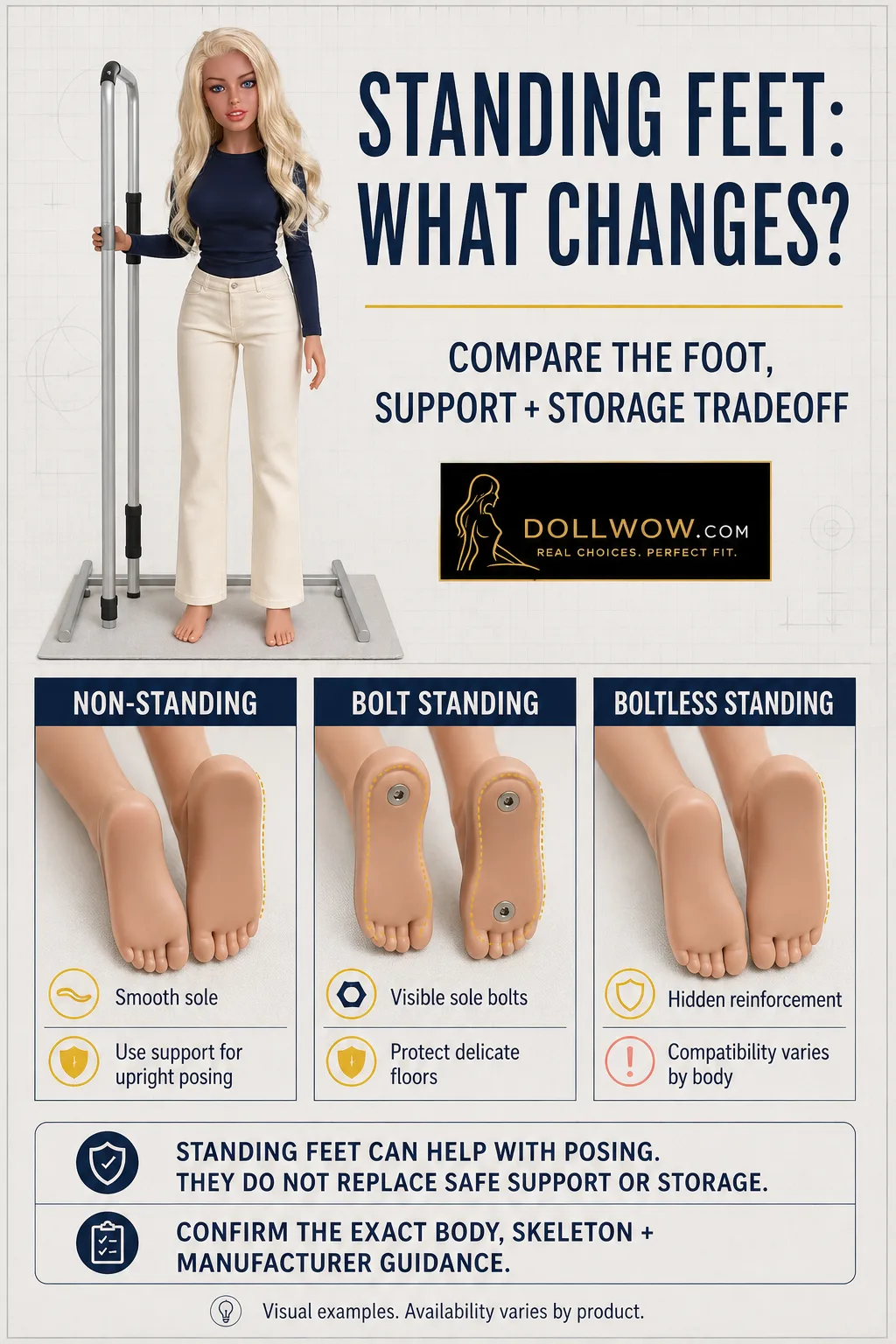
| Factor | Soft or non-standing feet | Exposed-bolt standing feet | Boltless standing feet |
|---|---|---|---|
| Upright use | Usually not intended to bear full weight | Designed for compatible standing use | Designed for compatible standing use |
| External support | Required for upright presentation | Often still recommended | Often still recommended |
| Sole appearance | Smoother and more natural | Visible contact hardware | Smoother appearance than exposed bolts |
| Floor contact | Soft material can compress or mark | Hardware needs a protective surface | Reinforced sole still needs floor care |
| Foot feel | Usually softer | Reinforcement changes the foot | Reinforcement may change firmness |
| Footwear | Depends on body and foot shape | Hardware and balance can limit shoe choices | Compatibility remains model-specific |
| Storage | Follow non-weight-bearing guidance | Do not assume long-term standing is safe | Do not assume long-term standing is safe |
| Availability | May be standard | Product-specific option or standard feature | Product- and manufacturer-specific |
The right choice depends on how often you expect to pose the doll upright, the surface available, how you will support the body, and whether foot appearance matters more than setup convenience.
Standing Does Not Mean Freestanding
A full-size doll has substantial weight and an articulated skeleton. Small changes in hip, knee, ankle, torso, or head position can move the center of gravity. A setup that appears balanced can still tip.
Treat external support as the safer default unless the current manufacturer instructions clearly state otherwise. A wall, purpose-designed stand, or another supported method can reduce fall risk, but the support surface and contact points must also be suitable for the doll's material.
Never use a standing option as permission to leave a heavy doll unattended in a precarious pose. A fall can injure a person, damage the doll, break nearby objects, and stress the skeleton or material.
Exposed Bolts Versus Boltless Standing Feet
Exposed-Bolt Systems
Exposed bolts or screws create defined contact points under the foot. Their practical advantage is that the hardware, rather than only soft material, can meet the supporting surface.
Check:
- Whether the hardware protrudes from the sole
- Whether protective caps or pads are supplied or recommended
- What surface should be placed underneath
- Whether the bolts can be adjusted and who should adjust them
- Whether shoes can be used without changing balance
- How the feet should be cleaned and dried around the hardware
Do not drag bolted feet across a floor. Lift and reposition according to the product's handling guidance.
Boltless Reinforced Systems
Boltless standing feet are designed to avoid obvious exposed contact hardware. They may offer a cleaner sole appearance, but the term does not explain the internal reinforcement or safe-use limits.
Confirm:
- The exact brand and body that supports the option
- Whether the system is standard or a paid upgrade
- Whether the sole is still firmer than a non-standing foot
- Which poses and surfaces are supported
- Whether shoes are permitted
- Whether long-term standing is discouraged
“Boltless” does not mean “no reinforcement,” “soft foot,” or “safe without support.”
How Standing Feet Affect Realism
There are two kinds of realism to compare.
Visual realism: A smooth sole can look more natural in photography or close inspection. Exposed hardware is more visible, especially when the feet are bare.
Practical realism: A compatible standing system can make dressing, photography, and upright presentation easier. That may matter more to a buyer who rarely focuses on the sole.
Foot shape, toes, nails, texture, body balance, ankle construction, and footwear also influence the result. Choose based on the whole use case rather than one close-up image.
Floor Protection
Standing places concentrated load through a small area. Protect both the doll and the surface.
Before setup:
- Use a clean, level, stable surface.
- Follow the manufacturer's recommendation for a mat, pad, or barrier.
- Avoid rough, sharp, unstable, wet, or heat-exposed flooring.
- Check that the contact material will not transfer dye.
- Keep the floor clear so the body can be moved without tripping.
- Do not slide or pivot the full weight across the feet.
Wood, tile, vinyl, carpet, and other surfaces behave differently. A solution safe for one floor may mark another, so confirm the current guidance and test protective materials away from the doll where practical.
Shoes And Footwear
Shoes can alter balance, pressure, hardware contact, and the angle of the ankle. They can also transfer dye or create pressure marks.
Ask before using footwear:
- Whether shoes are supported with the standing system
- Whether a flat sole is required
- How much clearance exposed hardware needs
- Whether socks or barriers are recommended
- Whether dark lining can contact the doll material
- Whether the shoes compress toes or change balance
Do not assume high heels are suitable because promotional photography shows them. Studio images may use hidden support and a temporary pose.
Skeleton, Ankles, And Body Weight
Standing feet work with the whole structure. The skeleton and ankle must transfer load while the hips, knees, torso, and feet keep the center of gravity controlled.
Confirm:
- Exact body and listed dry weight in pounds and kilograms
- Skeleton type
- Articulated or fixed ankle details where available
- Whether the foot option is compatible with that skeleton
- Recommended support points
- Poses the manufacturer allows
- Any maximum duration or storage restriction stated for the product
A lighter doll may be easier to set up, but lighter weight does not prove that its feet support standing. A heavier doll with standing feet may still be difficult for one person to position safely.
Safer Setup Sequence
Use the exact manufacturer instructions first. A conservative general sequence is:
- Clear the route and prepare a stable protective surface.
- Position the external support before lifting the doll upright.
- Use an appropriate lifting method for the listed weight.
- Align the legs and feet without forcing a joint.
- Bring the doll against the support gradually.
- Confirm that both feet and the support share the load as intended.
- Step back only after checking stability from more than one angle.
- Stay close during clothing, photography, or pose changes.
If the doll resists a position, stop. Do not use body weight or sudden force to make the skeleton comply.
Standing For Dressing Or Photography
Short, supervised upright use can be helpful for dressing, adjusting presentation, taking photographs, moving between nearby supported positions, or inspecting the body after arrival.
Plan the pose before lifting. Gather clothing, supports, and camera equipment first so the doll does not remain upright while you search for supplies.
Any image that shows a doll standing should be treated as presentation, not proof that the same body can remain unsupported or stand indefinitely.
Long-Term Storage
Standing feet do not automatically make upright storage appropriate. Long-term load can affect the feet, ankles, skeleton, material, and balance. Heat, pressure, sunlight, and contact materials add further risk.
For storage:
- Follow the product's approved position and support method.
- Keep pressure distributed as instructed.
- Avoid unstable corners or routes where the doll can be bumped.
- Protect the material from dye transfer and heat.
- Inspect the feet, ankles, and contact points periodically.
- Use the sex doll storage guide to plan space before ordering.
If upright storage is essential, make that requirement clear to DollWow before choosing a body. We can ask the manufacturer for the exact storage guidance rather than guessing from the option name.
Ready-To-Ship And Custom Orders
A ready-to-ship unit has an existing foot construction. Confirm whether it is non-standing, exposed-bolt, or boltless and whether the gallery reflects that exact unit.
A made-to-order product may allow the standing option to be selected during configuration. Eligible custom orders receive Human Build Check before production, which is the right time to verify the body, skeleton, foot system, appearance, price, and any incompatible choices.
Standing reinforcement may not be a practical post-production upgrade. If you expect to use it, decide before the build begins.
Buyer Checklist
Before adding standing feet, confirm:
- Exact brand and body
- Full-doll product form
- Listed height and dry weight in US and metric units
- Skeleton and ankle construction where available
- Non-standing, exposed-bolt, or boltless foot type
- Whether the option is standard or adds cost
- Whether external support is required
- Supported floor protection
- Footwear compatibility
- Effect on appearance and firmness
- Safe poses and any duration limits
- Storage guidance
- Production and factory-media process
- Repair path if the foot or ankle is damaged
Send the product link through live chat or [email protected]. Tell us whether your goal is dressing, photography, display, or storage. We will confirm the available option and the questions that need a manufacturer answer before production.
Common Mistakes
Assuming Standing Feet Means Unsupported Standing
External support may still be required. The label does not guarantee balance.
Leaving A Doll Upright Unattended
A fall can damage the doll and create a serious safety risk. Supervise standing setups.
Ignoring The Floor
Hardware and concentrated weight can mark surfaces. Use the confirmed protective method.
Dragging The Feet
Sliding or pivoting full weight can stress the feet, ankles, material, and floor.
Copying A Promotional Pose
Photography may use hidden supports, temporary balance, or a different body specification.
Treating Standing As Storage Approval
Occasional posing and long-term storage are different use cases. Confirm both separately.
Helpful DollWow Links
- Browse custom dolls
- Review the customization process
- Compare skeleton options
- Plan storage
- Compare lightweight dolls
- Review Care for Life
- Ask DollWow support
FAQs
What Are Standing Feet On A Sex Doll?
Standing feet are a manufacturer-supported foot construction intended to help a compatible doll bear weight through the feet during limited standing or posing. The system may use exposed bolts, boltless reinforcement, or another supplier-specific design.
Can A Sex Doll Stand By Itself With Standing Feet?
Do not assume it can. Balance depends on the body, skeleton, joints, pose, surface, and support method. External support is the safer default unless the exact manufacturer guidance states otherwise.
What Is The Difference Between Bolted And Boltless Standing Feet?
Bolted feet use visible hardware as contact points. Boltless systems avoid obvious exposed bolts but still use product-specific reinforcement. Both need confirmed support, floor, footwear, and storage guidance.
Are Boltless Standing Feet Better?
They can offer a smoother sole appearance, but they are not automatically softer, safer, or compatible with every body. Choose from the exact manufacturer's supported options.
Are Standing Feet Worth It?
They may be worthwhile for supervised dressing, photography, or upright posing. They are less useful when soft foot appearance matters most or you do not plan to stand the doll.
Do Standing Feet Affect Realism?
They can. Exposed hardware changes the look of the sole, while any reinforcement may affect foot firmness. Boltless options can preserve a smoother appearance.
Can Standing Feet Damage Floors?
Hardware or concentrated weight can mark some surfaces. Use a clean, stable protective surface recommended for the exact foot system and flooring.
Can A Doll With Standing Feet Wear Shoes?
Sometimes, but shoe shape, lining, sole, hardware clearance, and balance matter. Confirm footwear guidance for the exact body and standing system.
Can Standing Feet Be Added Later?
Do not assume so. Standing support can be part of the original foot and skeleton construction. Confirm the option before production.
Are Standing Feet Safe For Long-Term Storage?
Not automatically. Long-term upright load can create different risks from short supervised posing. Follow the exact storage guidance for the body and material.
Does A Lightweight Doll Still Need Standing Feet?
Light weight can make setup easier, but it does not make soft feet load-bearing. Foot construction and manufacturer guidance still decide compatibility.
Can DollWow Confirm Standing-Feet Compatibility?
Yes. Send the product and intended use through live chat or email. DollWow can check the available foot system, skeleton, price, production path, and manufacturer guidance before the build begins.