


Quick Answer
Choose TPE if you want a softer, more elastic feel and a lower typical starting price. Choose full silicone if you value crisp sculpt detail, a more structured feel, and a surface that is generally less porous. Consider a hybrid doll, usually a silicone head on a TPE body, if you want silicone facial detail with a softer body and a price between the two.
There is no universal winner. Material does not reliably predict the doll's finished weight, lifespan, or care routine by itself. Brand formulation, body size, internal foam, skeleton design, surface finish, and storage habits all matter. Compare the exact listing and ask for product-specific care instructions before using any cleaner, powder, oil, or repair product.
Key Takeaways
- TPE is usually softer, stretchier, and less expensive at the starting price.
- Full silicone often holds finer sculpt detail and is generally less porous, but it still needs thorough cleaning and drying.
- Hybrid construction is a distinct third option, not a full-silicone doll at a lower price.
- Material alone does not tell you whether a doll will be light or heavy. Size, foam cores, skeletons, and weight-reduction designs can outweigh the material difference.
- Terms such as "platinum silicone" describe a curing method. They do not automatically prove medical-grade status, a certification, or suitability for every use.
- The safest care rule is to follow the instructions for the exact brand and model.
TPE, Full Silicone, and Hybrid Construction
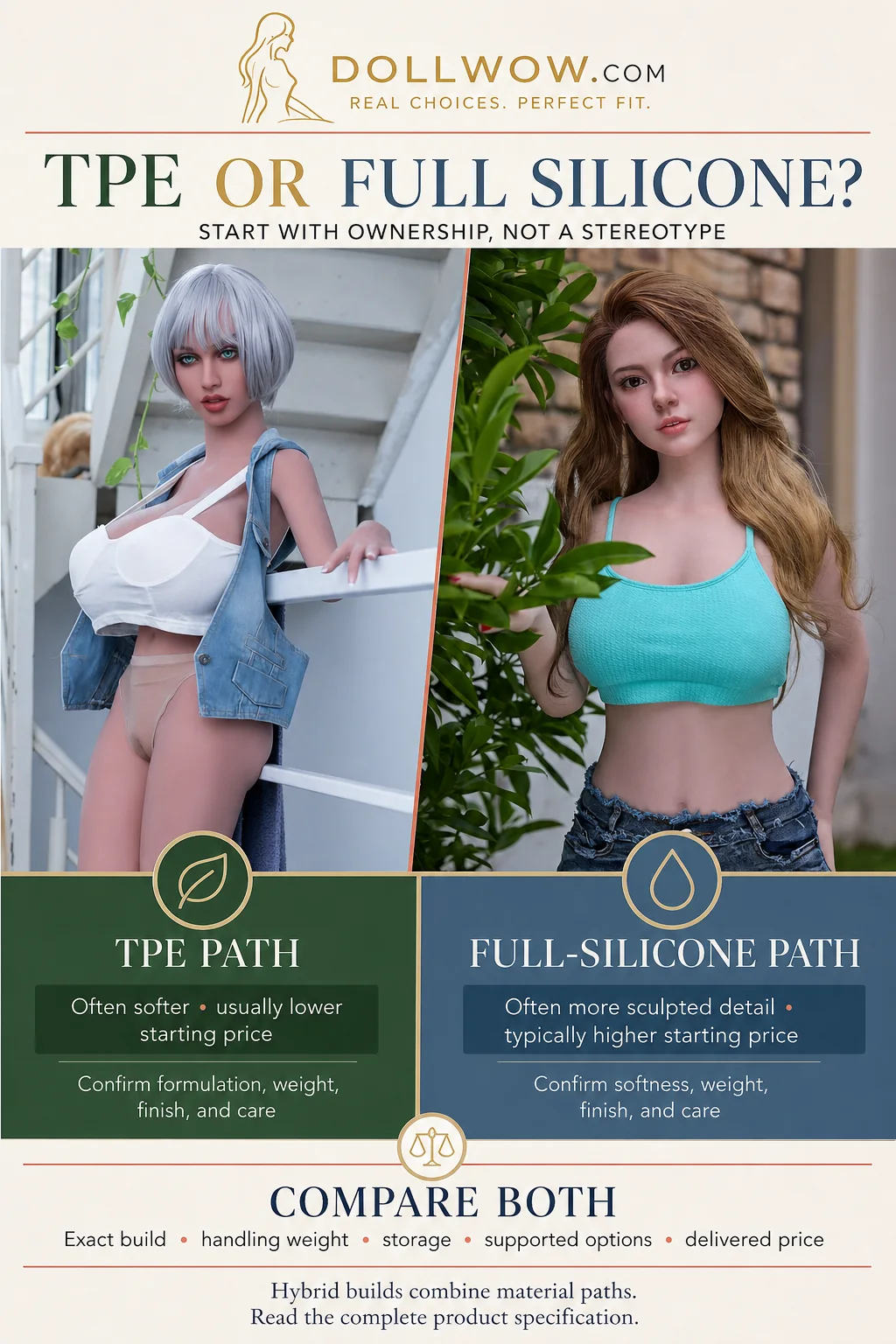
What is TPE?
TPE stands for thermoplastic elastomer. It is a family of flexible materials rather than one universal recipe. In sex dolls, TPE is commonly chosen for softness, elasticity, and value. Many TPE bodies feel more yielding when pressed and can offer substantial flexibility around the surface.
The tradeoff is that TPE is generally more porous than silicone. It can also be more vulnerable to staining, pressure marks, excess heat, incompatible products, and tears around high-stress areas. Some manufacturers recommend periodic powdering or other surface care, while others specify a different routine. Use the instructions supplied for the exact doll.
What is full silicone?
A full-silicone doll uses silicone for both the head and body exterior. Silicone formulations vary in firmness, softness, finish, and tear resistance. Compared with TPE, silicone often supports sharper facial and body detail and a more structured surface feel.
Silicone is generally less porous than TPE, but "less porous" does not mean self-cleaning or maintenance-free. Openings, seams, textured areas, and any removable parts still need careful cleaning and complete drying. Do not boil, heat, or sterilize a full doll unless the manufacturer specifically approves that method for the complete product.
What is a hybrid doll?
In this market, hybrid most often means a silicone head paired with a TPE body. The appeal is straightforward: silicone can preserve crisp facial detail, while the TPE body supplies a softer feel and a lower typical price than a comparable full-silicone build.
Check the listing carefully. "Silicone head" does not mean "full silicone," and hybrid care may require two material routines. Keep incompatible products away from both surfaces and ask the manufacturer or DollWow support before allowing different materials or care products to remain in contact during storage.
TPE vs Silicone Comparison Table
| Buying factor | TPE | Full silicone | Hybrid |
|---|---|---|---|
| Typical starting price | Usually lower | Usually higher | Often between TPE and full silicone |
| Feel | Often softer and more elastic | Often firmer or more structured | Silicone facial detail with a softer TPE body |
| Sculpt detail | Can be realistic, depending on the mold and finish | Often supports crisp facial and body detail | Usually strongest at the silicone head |
| Porosity | Generally more porous | Generally less porous | Care differs between head and body |
| Stain sensitivity | Often more vulnerable to dye transfer | Can still stain, especially with prolonged contact | Protect both materials according to their instructions |
| Surface care | May require powder or conditioning specified by the maker | Usually does not use the same powdering routine as TPE | Follow separate head and body guidance |
| Repair | TPE repair methods are formulation-specific | Silicone repair requires compatible silicone products and technique | Repair method depends on the damaged section |
| Weight | Varies widely by size and construction | Varies widely by size and construction | Varies widely by size and construction |
| Best fit | Softer feel and value priorities | Detail and structured feel priorities | Buyers who want a deliberate middle path |
Which Material Feels More Realistic?
Realism is personal. Some buyers use the word to mean softness. Others mean facial detail, skin texture, posing, weight distribution, or how the doll photographs.
TPE often wins for a soft, yielding first impression. Its elasticity can make some areas feel more pliable. Silicone often wins for defined sculpt work, stable surface texture, and a firmer response. Neither description applies equally to every brand. A soft-silicone formulation can feel very different from a firmer silicone, and premium TPE can differ significantly from an entry-level blend.
Look beyond close-up promotional photos. Review the doll's height, listed weight, body measurements, skeleton features, hand and foot detail, head attachment, and whether the images show the exact body and head combination. For a first purchase, those practical details usually matter more than a broad promise of "realistic feel."
Price and Long-Term Value
TPE sex dolls usually enter the market at a lower price than comparable full-silicone dolls. DollWow's current catalog reflects that broad pattern, although brand, height, body design, head choice, and customization can move an individual model well outside the usual range.
The lowest price is not always the lowest ownership cost. Consider:
- The exact included head and body configuration
- Paid upgrades and custom options
- Shipping and delivery terms
- Care supplies recommended by the manufacturer
- Storage equipment or a stand
- Repair complexity and replacement-part availability
- Whether the doll is ready to ship or made to order
Compare like with like. A compact TPE model and a tall silicone model do not reveal the price difference caused by material alone. Start with similar heights, body types, and configurations, then compare the final checkout value.
If you find the same legitimate configuration for less, review the DollWow Best Price Guarantee before ordering.
Weight and Handling: Material Alone Is Not Enough
Search results often make conflicting claims about whether TPE or silicone is heavier. The conflict exists because finished dolls are not solid blocks of one material.
At the same volume, a particular silicone formulation may be denser than a particular TPE formulation. In a finished doll, however, the amount of material, body proportions, internal foam, hollow sections, skeleton, and weight-reduction engineering change the result. Current DollWow products include full-silicone models that weigh less than larger TPE models, as well as heavy examples in every construction category.
Use the listed weight of the exact product. Then plan how you will lift, position, clean, and store it. A difference of 10 lb (4.5 kg) is noticeable in routine handling. A doll around 80 lb (36.3 kg) may require a very different setup from one around 55 lb (24.9 kg), regardless of material.
Before checkout, confirm:
- Height in feet and inches and centimeters
- Weight in pounds and kilograms
- Whether the stated weight includes the head
- Whether the model has a lightweight or foam-core design
- Where it will be stored and how far it must be carried
Read the original sex doll size and weight guide and storage guide before buying a model near the upper end of what you can comfortably handle.
Cleaning and Hygiene
Both TPE and silicone need a gentle, repeatable cleaning routine. The exact process should come from the product manufacturer because formulations, finishes, electronics, and removable parts differ.
General care principles for both materials
- Confirm the material and manufacturer instructions.
- Use only a compatible mild cleaner and soft cloth or tool.
- Keep water away from electronics and unsealed openings.
- Rinse only where the product instructions allow it.
- Dry every cleaned surface and internal area completely.
- Store the doll away from heat, direct sunlight, moisture, pressure points, and dye-transfer risks.
TPE's greater porosity makes thorough cleaning and drying especially important. Full silicone is generally less porous, but seams, cavities, and textured areas can still retain moisture. No material label removes the need for hygiene.
Avoid universal internet recipes. Alcohol, bleach, strong solvents, abrasive tools, high heat, and unapproved oils can damage a surface or finish. Read the full sex doll cleaning guide and follow the care information supplied with your doll.
Powdering, Oils, and Surface Products
TPE products are sometimes powdered after cleaning and drying to reduce tackiness and protect the surface feel. Some owners also encounter advice about oils or conditioners. These practices are not interchangeable across every TPE formulation.
Silicone generally follows a different care path. Applying a TPE-oriented oil, powder, silicone lubricant, adhesive, or sealant to the wrong surface can create staining, swelling, tackiness, bonding problems, or other damage.
Use a product only when the doll manufacturer confirms compatibility. When in doubt, test nothing on the doll and ask first. Product-specific restraint is cheaper than repairing a reaction.
Staining and Storage
Dark or highly saturated fabrics can transfer dye to either material. TPE is often more susceptible, but silicone is not immune. New clothing is a common risk because excess dye can release through moisture, friction, and prolonged contact.
Safer habits include:
- Wash new clothing separately until the rinse water runs clear.
- Test fabric against a hidden sample or inconspicuous area when the manufacturer permits it.
- Use light, colorfast storage fabric.
- Remove dark outfits after a short session instead of storing the doll in them.
- Keep different soft materials separated during long-term storage unless compatibility is confirmed.
- Avoid sustained pressure on the breasts, buttocks, fingers, toes, and other soft or projecting areas.
The best storage position depends on the skeleton, body design, hanging hardware, and manufacturer guidance. A dedicated case, supported flat position, or approved hanging system may be appropriate. See the complete storage guide for planning questions.
Durability and Repair
Silicone is often presented as the automatically more durable material. That is too simple. Silicone can hold detail well and may resist some surface changes, but it can still tear at stressed joints, fingers, seams, or openings. TPE can be highly flexible, but it may be more vulnerable to punctures, compression, staining, and surface reactions.
The most useful durability factors are:
- Quality of the manufacturer's formulation and molding
- Skeleton and joint design
- Thickness around high-stress areas
- How the doll is lifted and positioned
- Cleaning and drying habits
- Storage temperature and pressure
- Compatibility of clothing, lubricants, cleaners, and repair products
Repair is material-specific. TPE repair products work by methods that are not appropriate for silicone. Silicone repairs require a compatible silicone system, correct preparation, and enough curing time. A visually similar adhesive is not proof of compatibility.
DollWow customers can use Care for Life for ownership guidance and repair-kit support under the published program terms. For any tear, cut, stain, or skeleton concern, photograph the area and ask before attempting a repair that could make the damage harder to correct.
Customization and Appearance
Material affects what a manufacturer can mold and finish, but it does not decide every option. Skin tones, heads, eye colors, wigs, implanted hair, breast options, skeleton upgrades, heating, standing feet, and other features vary by brand and model.
Some options are conditional or incompatible. A head function may affect hair choices. A specific body may support only a subset of heads. A skin-tone selection may look different across TPE and silicone. The live product configurator and supplier confirmation should take priority over a generic brand list.
If an appearance detail matters, ask for confirmation before production. For custom builds, DollWow can help review the selected configuration and any available pre-shipment images under the applicable order terms.
Who Should Choose TPE?
TPE is a strong starting point when you:
- Prefer a softer, more elastic surface feel
- Want a lower typical entry price
- Have found a specific TPE body whose measurements fit your space and handling ability
- Are comfortable following a careful cleaning, drying, clothing, and storage routine
- Value a particular TPE-only body or brand formulation
Do not choose TPE only because it is cheaper. Make sure the doll's size, weight, care requirements, and configuration remain practical after the initial purchase.
Who Should Choose Full Silicone?
Full silicone is a strong fit when you:
- Prioritize crisp sculpting and a more structured surface
- Prefer a generally less-porous material
- Have budgeted for the higher typical starting price
- Want a full-silicone head and body rather than a mixed build
- Have compared the exact model's weight and handling requirements
Do not assume a premium price proves a universal safety grade, longer lifespan, or easier handling. Verify the manufacturer's claims and the exact product specifications.
Who Should Choose a Hybrid Doll?
A hybrid can make sense when you:
- Want silicone facial detail and a softer TPE body
- Prefer a price point between many TPE and full-silicone options
- Understand that the head and body may need different care
- Are comfortable confirming material compatibility before using products or storing removable parts together
Hybrid is not a compromise in quality by definition. It is a deliberate construction choice. Judge it by the specific head, body, connection system, and care instructions.
Buyer Checklist Before Checkout
- Is the doll full TPE, full silicone, or hybrid?
- What are the listed height and weight in US and metric units?
- Does the weight include the head?
- Is there a foam core or weight-reduction design?
- Which head, body, skin tone, and options are included in the displayed price?
- Is the listing ready to ship or made to order?
- Which care products does the manufacturer approve?
- Are there material-specific clothing and storage warnings?
- What support is available if a cut, stain, or joint concern appears?
- Can the seller confirm unclear details before payment?
Common Buying Mistakes
Treating all silicone as medical grade
"Platinum-cured" or "platinum silicone" describes a curing approach. It does not automatically establish medical-grade certification, testing, or suitability for every use. Look for a specific, verifiable manufacturer claim when that distinction matters.
Assuming silicone is always lighter or heavier
Finished weight depends on the complete construction. Compare the exact product weight, not a material slogan.
Calling a silicone-head doll full silicone
A silicone head on a TPE body is a hybrid. The distinction affects price, feel, care, and repair.
Using the same products on both materials
Cleaners, powders, oils, lubricants, and repair products may not transfer safely from one formulation to another. Confirm compatibility first.
Ignoring the storage plan
A material that looks ideal online can become impractical if the doll is too heavy to move or has nowhere to rest without pressure, heat, moisture, or dark fabric contact.
A Practical Final Recommendation
For a first doll, shortlist one TPE model, one full-silicone model, and one hybrid with similar height and proportions. Compare the final price, listed weight, included options, stock path, and care instructions side by side.
Choose the product whose complete ownership routine fits your life. A well-matched TPE doll is a better purchase than an impractical silicone doll, and a well-matched silicone doll is worth the premium when its detail, feel, and construction are the features you actually value.
Browse TPE dolls, full-silicone dolls, and hybrid dolls, or use the DollWow finder to narrow the catalog by material, size, body type, and delivery preference.
FAQs
Is TPE or silicone better for a first sex doll?
TPE often offers a softer feel and lower starting price, while full silicone often offers crisper detail and a more structured surface. For a first doll, the better choice is the model whose weight, measurements, care routine, and price fit your real space and handling ability.
Which feels softer, TPE or silicone?
TPE is often softer and more elastic. Silicone often feels firmer or more structured, although soft-silicone formulations exist. Brand formulation and body construction can produce noticeable differences within either category.
Is silicone easier to clean than TPE?
Silicone is generally less porous than TPE, but both materials require careful cleaning and complete drying. Cavities, seams, textured surfaces, electronics, and removable parts can change the correct routine, so follow the instructions for the exact model.
Does silicone last longer than TPE?
Not automatically. Material formulation, molding, skeleton design, handling, cleaning, storage, and compatible product use all affect lifespan. Neither material label is a warranty against tears, stains, or joint problems.
Are silicone sex dolls heavier than TPE dolls?
Not reliably. Material density is only one input. Height, proportions, material volume, foam cores, skeletons, and weight-reduction designs determine the finished weight. Use the listed weight for the exact doll.
What is a hybrid sex doll?
A hybrid sex doll usually combines a silicone head with a TPE body. It can offer detailed facial sculpting with a softer body, but the two sections may require different care and repair products.
Does platinum silicone mean medical grade?
No. Platinum silicone refers to a curing system. Medical-grade status requires specific material standards, manufacturing controls, or testing claims that should be verified with the manufacturer.
Can TPE and silicone touch each other in storage?
Compatibility varies by formulation and by any products left on the surfaces. Do not assume prolonged contact is safe. Follow the manufacturer's storage guidance and keep materials separated when compatibility has not been confirmed.
Can I use the same cleaner and lubricant on both materials?
Only if the product is explicitly confirmed as compatible with the exact TPE or silicone formulation and the doll's construction. Avoid universal internet recipes and check the manufacturer's care instructions first.
Where can I compare TPE and silicone dolls side by side?
Use the live DollWow product examples below, then compare the full TPE collection, silicone collection, and hybrid collection. Check exact height, weight, price, configuration, and availability on each product page.