

Quick Answer
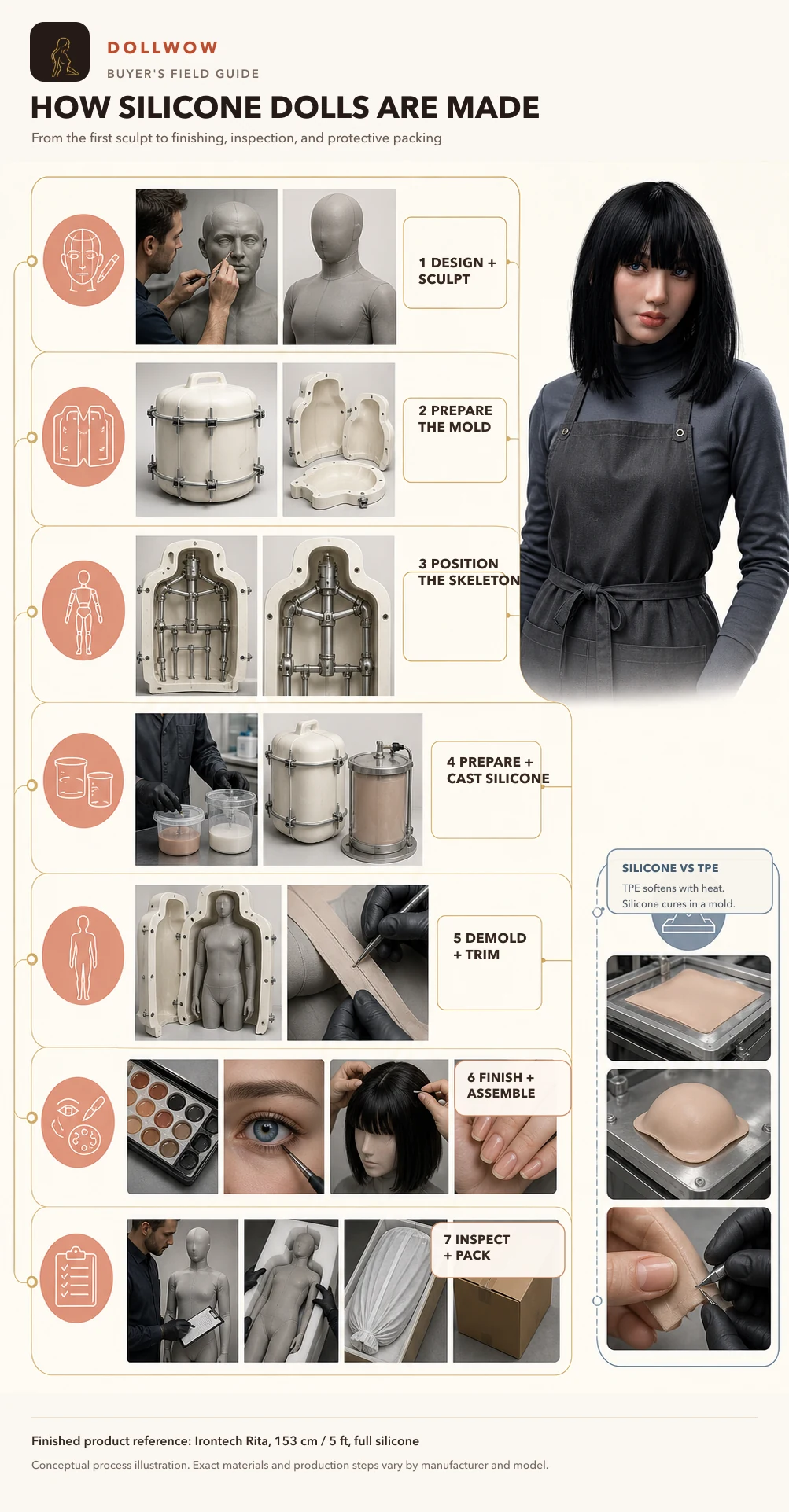
Most silicone sex dolls begin with a sculpt and production mold. A metal skeleton and any supported internal structure are positioned inside the body mold, color-matched silicone is mixed and cast around it, and the cured body is removed for trimming, surface repair, painting, detailing, assembly, and inspection. Heads commonly follow a separate molding and finishing path before the final body, head, options, and appearance are checked for shipment.
Key Takeaways
- A doll is a system of sculpt, mold, skeleton, internal structure, outer material, finish, head, and selected options.
- Silicone heads and bodies may be produced separately, even when the finished product is sold as a complete doll.
- Casting is only one part of the work. Trimming, surface correction, painting, eyes, hair, nails, assembly, and inspection can change the final result.
- TPE and silicone do not follow one interchangeable production method.
- A factory photograph shows a production-stage unit, not every internal step or every included option.
- Manufacturing explanations are useful for judging listings, but the exact brand documentation controls the exact product.
- Buyers should confirm the final body, head, material, finish, options, and approval process before production begins.
Why Manufacturing Matters to a Buyer
A production guide should do more than satisfy curiosity. Each manufacturing stage connects to something a buyer will later see, handle, clean, store, or ask support to resolve.
The sculpt and mold influence proportions and surface detail. The skeleton influences pose and support. Internal foam or weight-reduction construction influences handling. Material preparation and casting influence the outer body. Trimming and finishing influence seams, color, texture, makeup, and small visual differences. Final assembly determines whether the selected head, eyes, hair, hands, feet, electronics, and accessories match the confirmed order.
This is why two dolls with the same height and material can still feel very different. The material label is only one layer of the finished product.
The Manufacturing Process at a Glance
| Stage | What normally happens | What the buyer should understand |
|---|---|---|
| Design and sculpt | A body and head are designed around intended proportions and features | Product photos should match the exact body and head, not merely a similar model |
| Mold preparation | Production molds are cleaned, assembled, and prepared for casting | Mold geometry affects shape, texture, openings, and visible parting lines |
| Skeleton construction | A metal frame and joints are built for the supported movement system | Skeleton labels and movement ranges are manufacturer-specific |
| Internal structure | The skeleton may receive foam, wrapping, cores, channels, or weight-reduction construction | Weight and softness cannot be predicted from material alone |
| Material preparation | Silicone or TPE is prepared using the factory's formulation and color process | Formulation, firmness, pigment, and process vary by brand and product line |
| Casting or molding | The outer material is formed around the supported internal structure | The method differs between silicone, TPE, heads, bodies, and specialty products |
| Cure, cool, and demold | The material sets before the product is removed from the mold | Freshly demolded parts still require substantial finishing work |
| Trim and surface correction | Excess material, fixation points, small voids, and mold edges are addressed | A visible seam is not automatically damage, but severe defects should be questioned |
| Paint and detail | Color, shading, makeup, nails, veins, texture, and other details may be applied | Finishing is partly manual, so exact appearance should be reviewed when eligible |
| Assembly and options | Head parts, eyes, hair, inserts, electronics, feet, and other supported choices are fitted | Options can conflict and must be checked against the exact body and head |
| Inspection and packing | The unit is reviewed, cleaned, protected, and prepared for transit | Approval media and arrival inspection serve different purposes |
1. Design, Sculpting, and Proportion
Production begins before any liquid material enters a mold. A manufacturer first needs a body or head design that can be reproduced consistently. The original form may involve physical sculpting, digital design, scanning, prototyping, or a combination. The exact method is a manufacturer detail, not a universal industry rule.
For buyers, the important question is whether the listing identifies the exact sculpt. A body name, head name, head number, or series should remain consistent across the title, gallery, measurements, options, and order confirmation. A photograph of one head on a similar body does not prove what another combination will look like.
Look for:
- Exact body height and core measurements in inches and centimeters
- Listed weight in pounds and kilograms
- Head model or reference
- Body and head material stated separately
- Skin tone or finish
- Whether the gallery shows the exact body, head, or a supported pairing
- Which visual details are standard and which are paid options
2. Creating and Preparing the Mold
Once a design is approved for production, a mold reproduces its shape. Head and body molds are commonly separate. Multi-part molds need joins, closures, and carefully controlled positioning. Those joins can leave a parting line that is later trimmed and finished.
Irontech's current factory process shows molds being cleaned and secured before silicone casting. Its head process also reserves positions for eyes and uses an internal core. The body process positions the skeleton and internal cores inside the mold before material is added.
The buyer lesson is simple: a mold creates the base geometry, but the demolded part is not the finished doll. It still needs trimming, correction, cleaning, paint, assembly, and inspection.
3. Building the Skeleton
The skeleton creates the internal support and joint system. Depending on the product, it can include a central frame, neck connection, shoulder, elbow, wrist, finger, spine, hip, knee, ankle, toe, and foot components. Not every product includes every articulated area.
Skeleton construction may involve cut and welded metal parts, fasteners, joint assemblies, hand and foot structures, and manufacturer-specific upgrades. A label such as flexible, shrugging, EVO, EXP, standing, boltless, or gel-joint does not describe one shared standard across all brands.
Before buying, confirm:
- Which skeleton is included in the shown price?
- Which movements are supported by the exact body?
- Are fingers, toes, shoulders, waist, or neck articulated?
- Does a standing option change the feet or skeleton?
- Do upgrades affect weight, production, care, or repair?
Use the skeleton options guide to compare these labels without assuming one brand's definition applies to another.
4. Positioning the Internal Structure
The skeleton must be positioned so it remains correctly located inside the finished body. Irontech's silicone process describes suspending the skeleton within the mold and preventing it from contacting the mold wall. The factory may also position internal cores, foam, wrapping, cavities, channels, connectors, and product-specific hardware.
This stage helps explain why an outer photograph cannot prove everything about the internal build. It also explains why a buyer should not request an unsupported mix of skeleton, body, heating, standing, gel, or electronic options. Internal space and production compatibility are finite.
Weight-reduction designs deserve particular care. Some silicone bodies use internal foam or another engineered structure to reduce the amount of dense outer material. The finished weight still depends on body size, skeleton, wall thickness, internal layout, and the manufacturer's process. “Lightweight” should always be checked against the exact listed weight.
5. Preparing Silicone
Silicone production can involve measuring, color matching, mixing, pigmenting, degassing, and casting according to a product-specific formulation. Irontech's documented process shows color-matched platinum silicone being mixed and vacuum-degassed before it is placed into the mold.
These steps should not be turned into a home recipe. Ratios, catalysts, cure behavior, pigments, equipment, ventilation, quality controls, and compatible mold materials vary. A factory process guide explains the product, not how to reproduce it safely outside a controlled production environment.
For buyers, silicone preparation can affect:
- Base skin tone
- Firmness and localized softness
- Surface consistency
- Bubble and void control
- Bonding around internal structures
- Cure and finishing behavior
- Compatibility with later paint or texture work
None of those qualities should be assumed from the word “silicone” alone.
6. Casting the Silicone Head
A detachable silicone head may be produced around an internal core with reserved eye positions and the supported neck connection. After material preparation, the silicone is placed into the mold and allowed to set according to the factory's process.
Once removed, the raw head can have excess edges, small surface imperfections, and unfinished openings. It then moves into trimming, repair, cleaning, makeup, eyes, hair, and other assembly work.
Head options can change the path. A hard head, soft head, articulated jaw, implanted hair system, heating feature, powered mouth, or electronic module may require a different internal arrangement. Confirm the actual head type rather than treating every photo of the same face as the same product.
7. Casting the Silicone Body
With the skeleton and supported internal structure positioned, the silicone body is formed in the prepared mold. The factory must control material distribution around the skeleton, foam, cores, and surface geometry. The exact pouring speed, zones, cure schedule, and quality checks belong to the manufacturer and can vary by product line.
After the material sets, the mold opens and the body is removed. Demolding exposes the basic shape, but it also begins a demanding manual stage. Excess material and fixation points need attention. Internal cores may need removal. The body may need cleaning before finishing or assembly.
8. How TPE Production Differs
TPE is a thermoplastic elastomer rather than a curing silicone system. It is generally processed through controlled heating and molding around a supported internal structure. Exact temperatures, injection methods, material blends, cooling, demolding, and finishing steps vary by manufacturer and should not be copied from a generic factory video.
Official Tantaly guidance confirms that its TPE products use metal skeleton structures and describes demolding as the final production stage before some surface-care preparation. It also notes that fresh TPE can release oil and may receive renewal powder before leaving the factory.
The buyer-facing differences include:
- TPE and silicone use different repair systems.
- Surface feel, oil behavior, porosity, care, and staining risk differ.
- A silicone head with a TPE body is a mixed-material product, not full silicone.
- Factory finish and care instructions should identify which material applies to each part.
Read the TPE versus silicone guide for the ownership decision, and use this page only for understanding how production choices reach the finished product.
9. Trimming, Surface Correction, and Cleaning
Freshly molded parts can show flashing, mold edges, fixation points, small holes, or other production marks. Skilled finishing teams trim excess material, address supported corrections, remove residue, and prepare the surface for paint or assembly.
A parting line is a normal consequence of a multi-part mold, but normal does not mean every line should be severe or poorly finished. Inspect product photos at the neck, shoulders, sides, hands, feet, and other mold-transition areas. If a production photo shows an unexpected tear, exposed hardware, major void, severe separation, or incorrect option, raise it before shipment.
Do not confuse normal hand finishing with permission to repair a new product yourself. Arrival concerns should be documented before applying glue, heat, pigment, powder, oil, or cleaner.
10. Painting and Surface Detail
After the base form is clean, artists may apply body tone, blush, veins, areola detail, nail color, freckles, makeup, muscle definition, texture, and other supported finishing work. Irontech's documented silicone process describes layered body painting and hand detail work after demolding and cleaning.
Manual finishing creates subtle variation. That is one reason eligible factory media can be useful for a custom order. It can confirm the selected appearance before the product enters transit, while there is still an opportunity to ask about a visible mismatch.
When comparing galleries, ask whether the photographed doll includes:
- Standard or upgraded makeup
- The same skin tone
- Hand-painted or applied nails
- A special texture or finish
- Implanted hair or a wig
- The exact eye color
- Clothing or styling that is not included
11. Eyes, Hair, Makeup, and Head Assembly
The finished expression comes from more than the mold. Eye selection and direction, lashes, brows, makeup, mouth detail, hairline, wig fit, and implanted hair can change how the same sculpt appears.
Implanted hair can require extensive manual work and may not be compatible with every head or powered feature. Wigs can be easier to change but still need the right cap fit, hairline, and storage routine. The implanted hair versus wig guide explains the ownership tradeoff.
Head and body pairing also needs confirmation. Connector, scale, neck transition, material, tone, finish, electronics, and supported options all matter. A face photograph alone does not prove compatibility with every body from the same manufacturer.
12. Installing Custom Options
Some choices affect appearance only. Others change the internal build or production path. Depending on the exact product, options can include skeleton upgrades, standing feet, heating, gel areas, softness systems, inserts, hair, eyes, oral structures, connectors, electronics, or accessories.
Options should be reviewed before production because:
- Some are installed inside the body or head.
- Some are mutually exclusive.
- Some require a specific material or body.
- Some change weight, price, care, or production timing.
- Some shown in factory marketing are not available on every model.
DollWow's Human Build Check reviews supported custom selections for missing choices and visible conflicts before production. The current product configurator and written supplier confirmation take priority over a generic option menu.
13. Final Inspection and Factory Media
Final inspection should compare the completed product against the confirmed order. The exact process varies, but useful checks can include body, head, tone, finish, eyes, hair, visible options, surface condition, joint behavior, accessories, and packaging preparation.
Approve Before Shipping applies when eligible factory photographs or video are available. This media is most useful when it is tied to a checklist:
- Is this the correct body and head?
- Are the material and skin tone correct?
- Are the visible paid options present?
- Do eyes, hair, makeup, nails, and finish match the order?
- Is there visible damage or a material mismatch?
- Are questions resolved in writing before approval?
Approval media cannot prove every internal component or future performance. It is one checkpoint, not a replacement for accurate order records, manufacturer documentation, protected payment, packing, tracking, and arrival inspection.
14. Packing for Shipment
After inspection and any eligible approval, the doll is cleaned and protected for transit. Packing may support the head, hands, feet, limbs, and other pressure-sensitive areas. The exact materials and included storage items vary, so do not infer them from another brand's unboxing video.
When the shipment arrives, document the sealed package, labels, outer condition, opening process, internal protection, and first view of the product. Compare the delivered product against the confirmed body, head, options, and factory media before discarding packaging or applying care products.
The discreet shipping guide covers privacy and delivery planning. The ordering guide explains DollWow's customer path from selection through arrival.
What Factory Photos Can and Cannot Prove
| Factory media can help confirm | Factory media cannot prove by itself |
|---|---|
| Visible body and head pairing | Internal construction hidden from view |
| Skin tone, eyes, hair, makeup, and nails | Exact formulation or long-term durability |
| Visible standing feet or other external options | Every electronic or internal feature works over time |
| Obvious surface condition before packing | Transit condition after the media was recorded |
| The photographed unit appears to match the order | Unshown accessories are included |
Use factory media actively, but keep the order confirmation and product documentation as the complete record.
How Manufacturing Changes the Buying Decision
If realism matters most
Inspect sculpt, mold detail, head finishing, eyes, hair, neck transition, surface paint, hands, feet, and consistency across several images. Material alone does not settle realism.
If handling matters most
Compare exact weight in pounds and kilograms, body dimensions in inches and centimeters, internal weight-reduction construction, lifting route, cleaning routine, and storage position.
If customization matters most
Choose the body and head first, then confirm each option against that exact pairing. Ask which choices are internal, which can conflict, and which must be decided before production.
If arrival confidence matters most
Use a written order record, Human Build Check, eligible factory media, protected payment, tracked shipment, and immediate documented arrival inspection.
Common Manufacturing Myths
“Silicone dolls are poured as one solid piece”
Many complete dolls use separate head and body production, an internal skeleton, and an engineered internal structure. Full silicone describes outer material construction, not a solid block with no internal components.
“Handmade means there are no molds”
Molds reproduce the base form. Handwork commonly appears in sculpt development, trimming, correction, painting, makeup, hair, assembly, and inspection.
“The factory gallery shows exactly what arrives”
The gallery may show styling and paid options. Confirm the exact configuration, included items, and eligible production media.
“A longer production time always means better quality”
Scheduling, material, order volume, options, rework, holidays, and inspection can all affect timing. Time alone is not a quality score.
“Every product from one brand uses the same process”
Manufacturers may use different materials, molds, skeletons, head systems, finishes, and option paths across product lines.
Buyer Checklist Before Production
- [ ] Exact manufacturer, body, and head confirmed
- [ ] Body and head materials stated separately
- [ ] Height and key measurements shown in US and metric units
- [ ] Weight shown in pounds and kilograms
- [ ] Skin tone and finish confirmed
- [ ] Skeleton and standing system confirmed
- [ ] Hair, eyes, makeup, nails, and other appearance options confirmed
- [ ] Internal, powered, or heating options checked for compatibility
- [ ] Final configured price confirmed
- [ ] Production and shipping stages kept separate
- [ ] Eligibility for factory photographs or video confirmed
- [ ] Arrival inspection and support path understood
Sources and Review Basis
This guide uses current manufacturer material from brands represented in DollWow's catalog. Manufacturer descriptions apply to their own products and should not be generalized without confirmation.
- Irontech: How To Make A Sex Doll
- Irontech: Material Lab
- Irontech: Manufacturing and Buying Overview
- Tantaly: Production and Material Oversight
- Tantaly: Cleaning and Maintenance Guide
FAQs
How are silicone sex dolls made?
They are generally built from a sculpt and mold, an internal metal skeleton and supported internal structure, prepared silicone cast around that structure, curing and demolding, trimming and correction, hand-applied finish, head assembly, options, inspection, and protective packing. Exact methods vary by manufacturer and product.
Are silicone sex dolls solid silicone?
Not necessarily. Many use a skeleton plus foam or another engineered internal structure beneath the silicone outer body. Ask for the exact construction and listed weight.
Are the head and body made together?
Often they are produced separately and assembled as a supported pairing. Some all-in-one designs exist, but they should be identified explicitly.
What is inside a silicone sex doll?
The exact build may include a metal skeleton, joints, internal foam or weight-reduction structure, cores or channels, connectors, and supported option hardware. Internal construction varies by product.
How long does a silicone sex doll take to make?
There is no safe universal timeline. Scheduling, body, head, finish, options, cure and finishing work, inspection, rework, and factory workload can all matter. Confirm the current estimate for the exact order.
Why do two dolls with the same material feel different?
Formulation, firmness, wall thickness, foam, body geometry, localized softness, skeleton, finish, and option construction can differ. Compare the exact product rather than the material label alone.
Why is there a line on the side of a doll?
Multi-part molds can create a parting line that is trimmed and finished after demolding. Ask about severe, separated, rough, or damaged areas, especially on a new product.
Are sex dolls handmade?
They combine molds, equipment, and substantial manual work. Trimming, correction, painting, makeup, hair, eyes, nails, assembly, and inspection may involve skilled hand finishing.
Is TPE made the same way as silicone?
No. TPE is a thermoplastic elastomer and silicone uses a curing system. Their material preparation, molding, surface behavior, care, and repair paths differ.
Can I change options after production starts?
Do not assume so. Internal or compatibility-sensitive options may be fixed once production begins. Submit changes immediately and wait for written confirmation before treating them as accepted.
Do factory photos prove every feature is correct?
They help verify visible appearance and options, but they cannot prove every internal component, included accessory, future performance, or transit condition. Use them with the complete written order record.
What if the exact doll or option I want is not listed?
Contact live chat or [email protected] with the manufacturer, model, body, head, and source link. DollWow can check authorization and supplier details. Most approved requests can be added within 4 to 6 hours once authorization and product details are confirmed.